


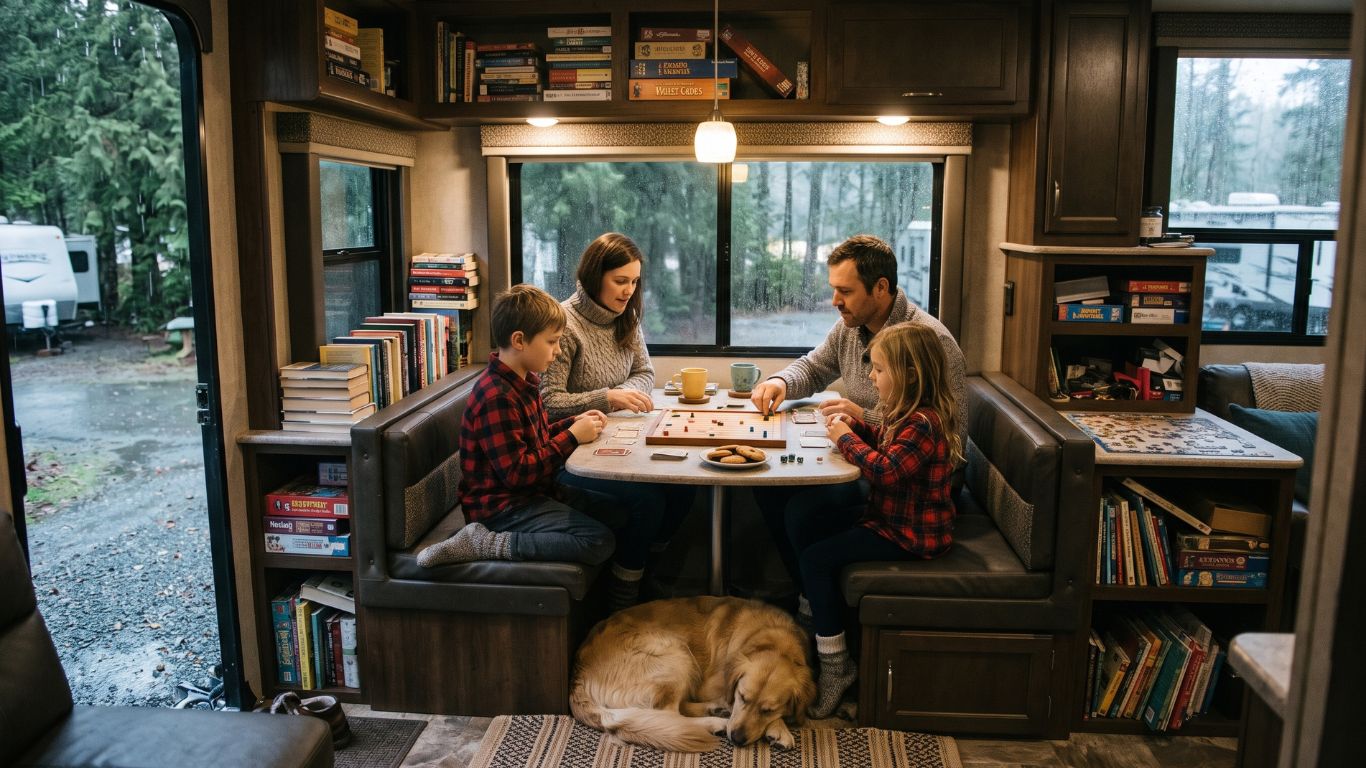
Let’s get the big question out of the way first. Can a family with school-aged kids really live full-time in an RV or a tiny home on wheels on the Sunshine Coast? Yes, plenty of families make it work. Is it right for every family? No, and anyone who tells you otherwise is selling something. (We do rent pads for a living, so we’re technically selling something too, but we’d rather you move in with your eyes open than leave in February with a grudge.)
This guide walks through the stuff parents actually ask us: where the kids go to school, what homeschooling looks like in BC, how much room you really need, and what a rainy November Tuesday feels like with two kids and a golden retriever in 300 square feet. Spoiler: it involves a lot of board games.
The Sunshine Coast is served by School District 46, and the good news for Halfmoon Bay families is that there’s an elementary school in the community itself. According to the district’s own list of schools, Halfmoon Bay Elementary runs kindergarten to Grade 7. Sechelt has several more elementary options (Davis Bay, Kinnikinnick and West Sechelt), and Chatelech Secondary in Sechelt covers Grades 8 to 12. The district also lists an alternative school and online programs for older students.
Here’s the part we want to be upfront about: which school your child is placed in depends on your address and the district’s catchment rules, not on what we say in a blog post. The district has a School Finder tool on its site, and the office can confirm which school serves a given address. Before you sign anything, do two things: check the School Finder, then phone the district office and tell them you’re planning to live at a long-term RV resort in Halfmoon Bay. Ask how they handle your address for registration. It’s a five-minute call that saves a lot of guessing, and it pairs well with our guide on using an RV park as your home address in BC.

We’re about two minutes off the Sunshine Coast Highway and roughly 20 minutes from Sechelt, so the drive to a Sechelt secondary school is a real part of the daily routine. The Coast has one main highway, which means a fender-bender or a downed tree can turn a 20-minute drive into something longer. Build in a little buffer in the morning and keep a thermos in the truck. If your family is coming over from the Lower Mainland, the BC Ferries schedule will also shape visits with grandparents and weekends away. Every Coast family eventually becomes a quiet expert in ferry timetables. You’ll pick it up.
We haven’t published bus routes here, because we don’t run them and they change from year to year. Ask the district about bus service for your specific address and the school you’re placed in. If there’s no stop right at the resort, the usual solution is a drive to the nearest pickup point or a drive to the school itself. Sort this out before move-in day, not after the first week of school.
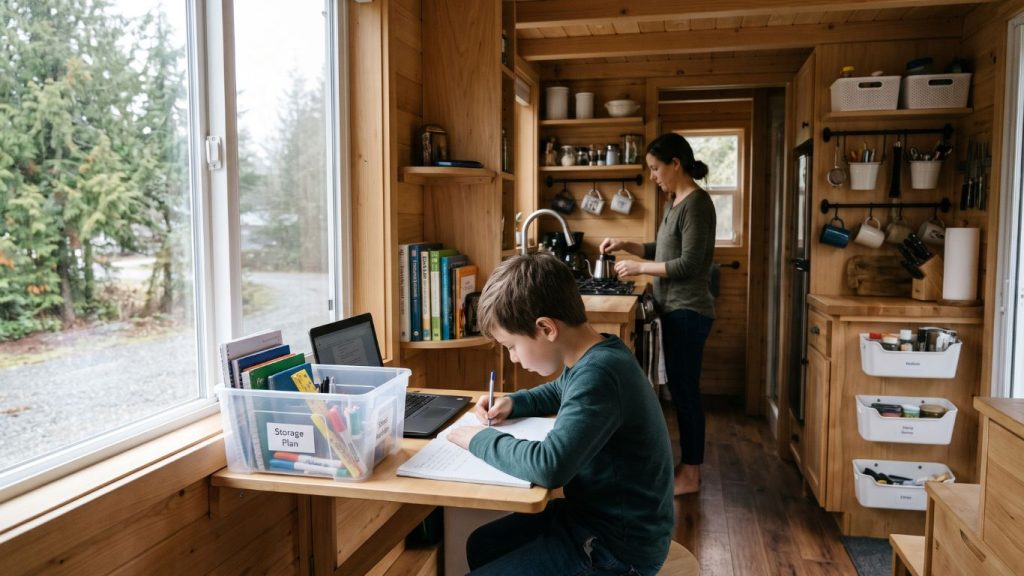
A lot of families who choose RV life also choose to homeschool, and BC makes this straightforward on paper. Per the Government of BC’s homeschooling page, children in the province must be educated, so homeschooled children must be registered. The page says parents who choose to homeschool must register their child by September 30 of each year. You can register through a public school, where the principal is required to register a homeschooled child, or through an independent school, which decides for itself whether to take homeschoolers and may charge a registration fee. The province’s page also notes that students in Grades 10 to 12 can take an online learning course and still be registered as homeschoolers.
That’s the legal outline, nothing more. The details of curriculum, assessment and what registration actually involves are worth a conversation with the registering school or your district, since they can change. What we can speak to from watching families come through is the day-to-day side: homeschooling in a small space works best when everyone has a “territory.” A fold-down table that’s only for school, a bin per child, a rule that the kitchen counter is not a desk. It sounds fussy, but it keeps the learning from swallowing the whole home.
Let’s talk square footage, because this is where the idea either clicks or doesn’t. A family of four in a travel trailer is a different thing from a family of four in a fifth wheel with a bunkhouse, and both are different again from a family of three in a tiny home on wheels with a proper loft. We’ve written a full breakdown on choosing between a THOW, a park model and a fifth wheel, and it’s worth reading before you buy anything.
For kids specifically, here’s what tends to matter most:
Be honest with yourselves about personalities, too. Some kids love a compact home and the cuddly feeling of everyone nearby. Some teens need a door that shuts. If you have one of those, plan the layout around that need first.
We live on the Coast, so let’s not pretend the weather is a footnote. November through March is damp, and a family indoors for a week of drizzle needs a plan. A few things that work: a mudroom-style routine at the door (boots off, wet jackets on a hook or in a bin), a good dehumidifier, and a set of games and projects that live in one drawer. Get a stack of library books, too. Coast kids tend to become strong readers and strong rain-jacket wearers at the same time.
Our forest setting means there’s no shortage of outdoor time when the clouds break, and the beaches are close. Our guide to Halfmoon Bay beaches is a handy place to start for a post-school walk.
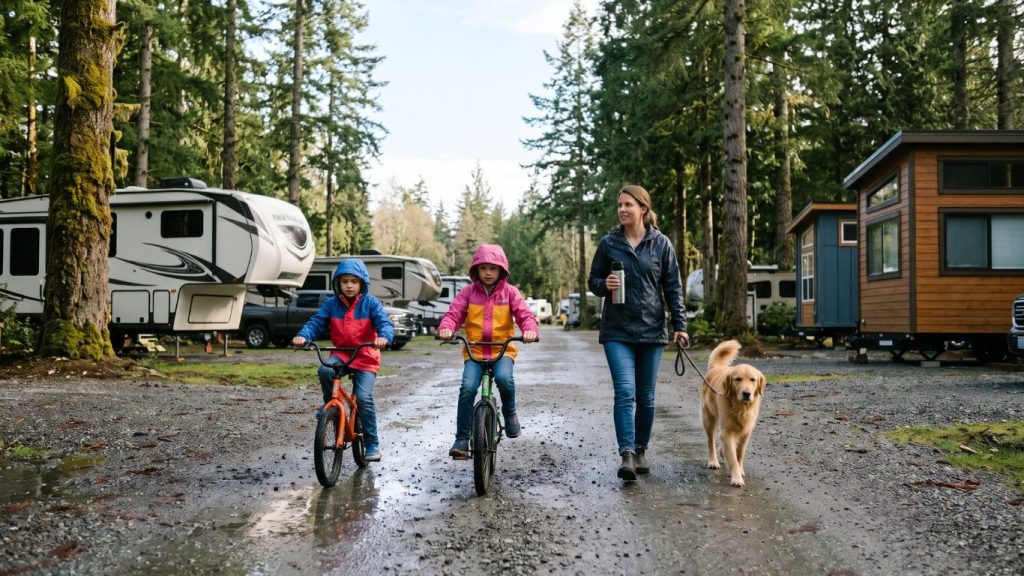
Kids and pets often arrive as a package deal. The resort is pet-friendly and has dog parks, and we have a separate guide to pet-friendly living at Halfmoon Bay if you’re bringing a four-legged family member. Bikes and scooters are part of Coast life too, but we haven’t posted a children’s policy or a quiet-hours schedule on our website, so ask the office how it all works before you move in. We’d rather you hear it directly than guess from a blog post.
Families who move in happily usually ask these up front, so steal the list:
Answer those five and you’ll be further along than most families who just show up with a trailer and optimism.
The families who thrive in a long-term RV or THOW setup usually share a few traits. They’ve chosen the lifestyle on purpose, not as a last resort. They’ve decided what they can live without. And they’re comfortable with a little improvisation, whether it’s a surprise power-bar overload or a school-pickup plan that changes in October. The families who struggle tend to underestimate rain, overestimate storage, and skip the conversation about how long they want to do this. That’s not a criticism, it’s just the pattern.
If you’re still on the fence, a practical test is to spend a weekend in your rig with the whole crew, in the rain, with everyone’s stuff. If you still like each other on Sunday night, that’s a good sign.
For the bigger picture of what year-round life looks like, our complete guide to living in an RV year round in BC covers the full list of practical questions.
Tell us how many people are coming, what you’re towing or parking, and when you’re hoping to move. We’ll point you to a pad that suits your rig and your power needs. Browse what’s available on our properties page, or call the office at (604) 218-4757 and ask us anything, including the awkward questions. We’ve heard them all, and we’ll have the kettle on.
 See map of resort