


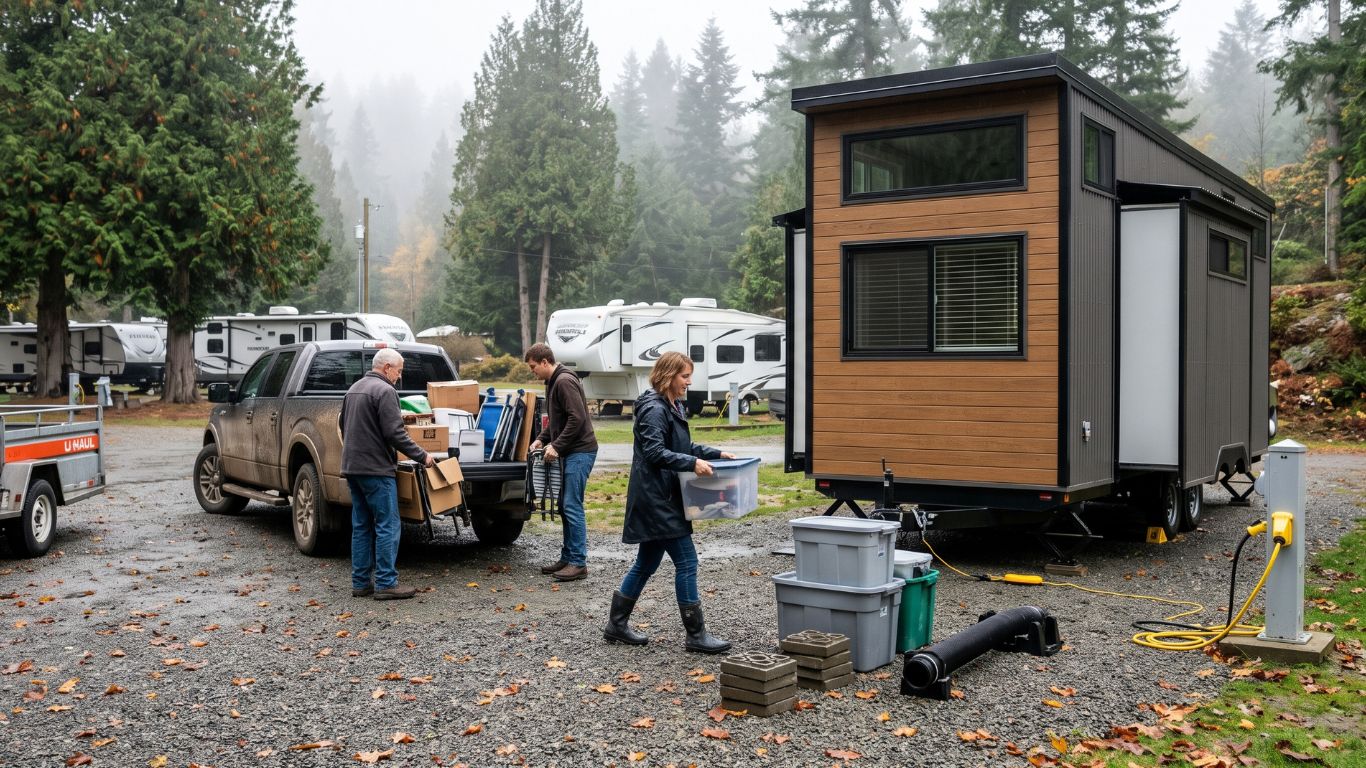
Every downsizing story starts the same way. Somebody opens the hall closet, an avalanche of towels, board games and one mysterious extension cord comes out, and a quiet voice says, “I own fourteen casserole dishes, don’t I?” You do. Most of us do. The good news is that moving into an RV or a tiny home on wheels (THOW) is the most motivating deadline a clutter collector will ever get, because a rig has walls, and walls do not stretch.
This is a practical guide to the stuff side of the move: what to sell, what to keep, what to store and what to send on its way. It is about logistics, not money advice, and it is written for people who are looking at year-round life on a serviced pad and wondering what on earth to do with a three-bedroom house worth of belongings.
Before you sort a single drawer, get the numbers for your actual rig. Not the brochure, the real thing: interior length and width, cabinet depth, closet space, and how much payload you have left once you add water, propane and yourselves. A fifth wheel, a travel trailer and a THOW can all feel very different once the furniture is in, and a lot of people are surprised that the limit is not floor space. It is storage volume and weight.
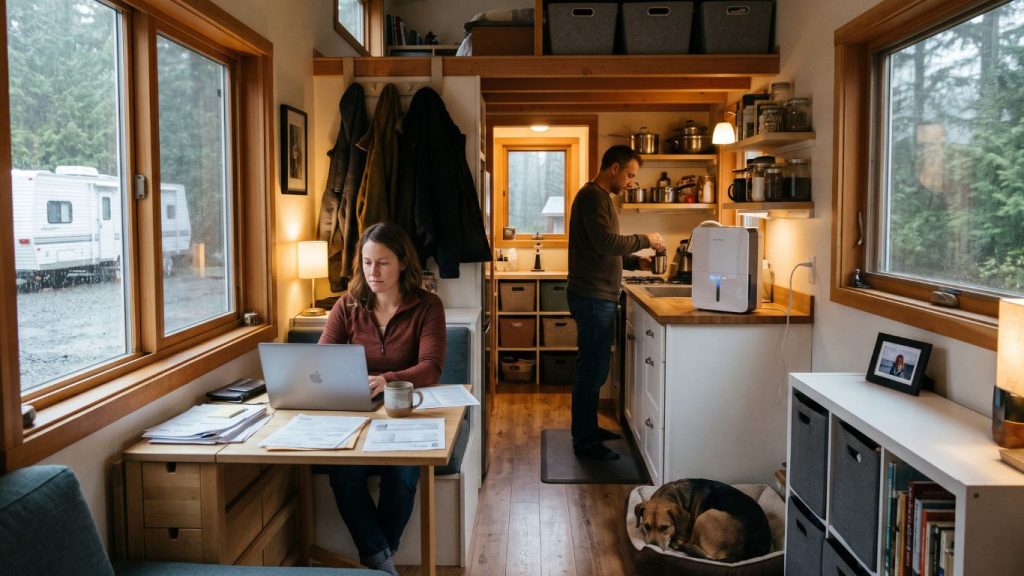
Grab a tape measure and a roll of painter’s tape and mark out the footprint of your rig on the garage floor or the driveway. Walk around inside the tape. Put a kitchen chair where the sofa will go. It sounds a bit silly, and your neighbours might wonder, but ten minutes with the tape will teach you more than any spreadsheet. If you are still choosing a rig, our guide to THOW vs park model vs fifth wheel walks through how each one handles space and year-round living.
Forget the elaborate methods with colour-coded stickers. All you need is four piles and a firm rule: every item has to land in one pile today. No “maybe” pile. The maybe pile is where downsizing goes to die.
The keep pile gets small and gets picky. Good candidates are things you use weekly, things that do two jobs, and things that make a space feel like yours. A good cast-iron pan stays. The bread machine you used twice in 2019 does not. Aim to keep a few items that are purely for joy, whether that is a framed print, a quilt or your grandfather’s tackle box, because a rig with no personality gets claustrophobic by February.
A few rules of thumb that tend to hold up:
Furniture that will not fit, the second fridge, the ride-on mower, the exercise bike that has become a very expensive clothes rack. These sell well locally, and Coast folks are generally good about picking up what they buy. Photograph things in daylight, price them to move, and set a deadline. Whatever has not sold in three weeks gets donated, no negotiating with yourself.
Do the big-ticket sales first. They free up floor space in the old house, which makes the rest of the sort feel less like wading through a flea market.
The storage pile needs the strictest rules, because a storage unit can quietly turn into a second house you pay to visit. Be honest about three categories: documents and keepsakes, seasonal gear you will actually use, and a small number of heirlooms. If you have not touched a box in a year, it is probably not storage, it is delayed donation.
Before you rent anything off-site, ask whether the stuff can live where you will. Halfmoon Bay RV Resort lists storage rooms on its site, and we cover local options in our guide to RV storage on the Sunshine Coast. Call the office about size, access and whether a room is heated or insulated before you plan around it, because that detail matters for photos, paper and anything that dislikes damp.

Some things are done. The Sunshine Coast makes this easier than you might expect, as long as you know where to go. The Sunshine Coast Regional District (SCRD) runs three recycling depots, in Gibsons, Sechelt and Pender Harbour, and per the SCRD recycling depots page they accept residential packaging and paper products through the Recycle BC program. Batteries are accepted at all of them. The same page is clear about what the depots do not take, including propane tanks, yard waste and unrepairable furniture, so check before you load the truck.
For the bigger stuff, the SCRD Sechelt Landfill page says large appliances like stoves, washers and dryers are recyclable for free if they contain freon, scrap metal is accepted with a tipping fee, and mattresses should be kept clean and dry in a plastic bag. The page lists the landfill as open Tuesday to Sunday, 9 a.m. to 5 p.m., closed Mondays, with no loads accepted after 4:50 p.m. Fees change, so confirm before you make the trip. Nobody wants to drive a loaded truck to Sechelt on a Monday and discover the gates have opinions about that.
This is where the casserole dishes live, and where the ruthless cuts happen. A small rig kitchen needs roughly one of everything: a good knife, a cutting board, two pots, a pan, a baking sheet, a set of dishes for the number of people who actually eat there, and a few mixing bowls that nest. Specialty gadgets are the first to go. Entertaining a crowd? Keep a few extra plates and cups in the storage room, not the galley.
Count your hangers, not your clothes. RV closets are narrow, and a full wardrobe will not squeeze in. Pick a season-and-a-bit approach: keep this season’s clothes plus a modest swap bin for the next. On the Coast, that means rain gear is not optional, and neither is a decent pair of waterproof boots. Warm layers earn their spot, the rest can travel in a tote.
Large sofas, bookshelves and entertainment units are the classic casualties. Digitize photos and documents where you can, keep only the originals you legally need, and be selective with books. One shelf of favourites, with a library card for the rest, is a very happy arrangement. Hobbies are worth a deliberate decision: a sewing machine, a guitar or a small woodworking kit might fit, a full workshop will not.
Keep a compact tool kit and the specific items for rig maintenance: a tire pressure gauge, a surge protector, a water pressure regulator, a drinking-water hose, levelling blocks. Everything else is negotiable. If you are staying on a serviced pad, you will not need a lawn mower, a snowblower or a pressure washer. Ladders, bikes and kayaks are worth deciding on early because they need somewhere to live. Our year-round RV living guide goes into what daily life on the pad looks like once the boxes are gone.
Downsizing in a weekend is a recipe for tears and regrettable donations. Give yourself six to eight weeks if you can, and work backwards from your move-in date.
Speaking of the ferry, if you are bringing a loaded trailer or truck across, check the current sailings on the BC Ferries schedules page before you commit to a travel day. A heavy, over-packed rig is a lot more stressful in a long line-up than a lean one.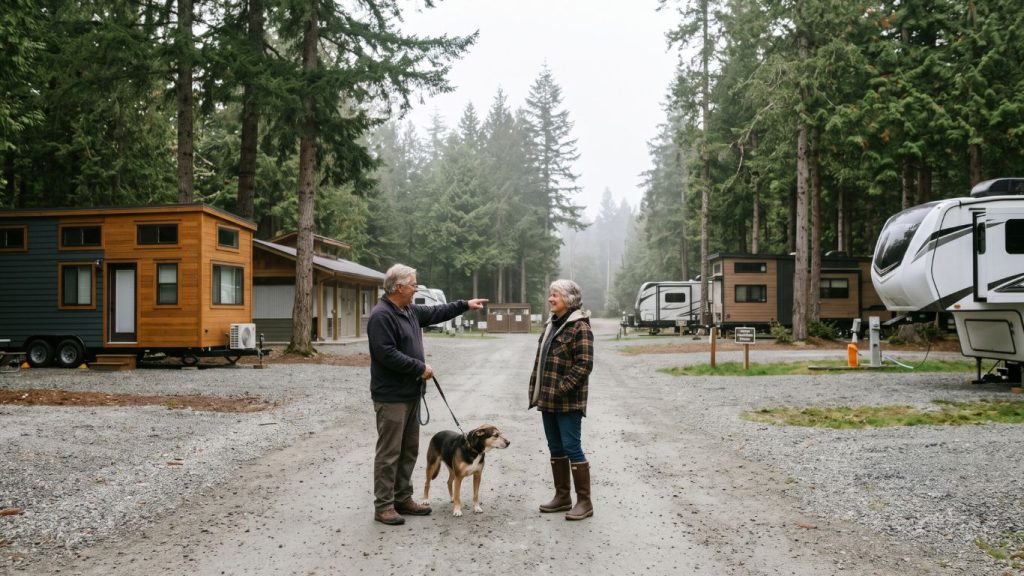
Letting go of a house is not really about the stuff. Each object carries a little story, and tossing it can feel like tossing a piece of the story. A few things help. Take a photo of the sentimental items you are not keeping, and put the best ones in a small album. Give family heirlooms to the people who will actually enjoy them, now, rather than later. And if something stings, stop for the day. The sort will still be there tomorrow, and so will the casserole dishes.
It is also worth saying that this is not for everybody. Some people love it, some find a rig too tight and move on to something with a bit more room. That is a fine outcome, and the sort you have done will pay off wherever you land. If you are weighing the move itself, our post on retiring in an RV in BC looks at what the lifestyle gives you in return.
Once the piles are gone, what’s left is the best part: a small, warm, well-organized home on a quiet pad in the trees, with a 24-hour laundromat and gym down the path, cable and Wi-Fi, and amps to suit a modest rig or a big one. Halfmoon Bay RV Resort is two minutes off the Sunshine Coast Highway, 20 minutes from Sechelt and 40 minutes from the Langdale ferry terminal, with 80 RV lots and year-round, fully serviced living.
Browse what is open right now on our available pads page, or call the office at (604) 218-4757, tell us what you are towing, and we will help you find a spot. Bring the good cast-iron pan. Leave about thirteen of the casserole dishes.

 See map of resort