


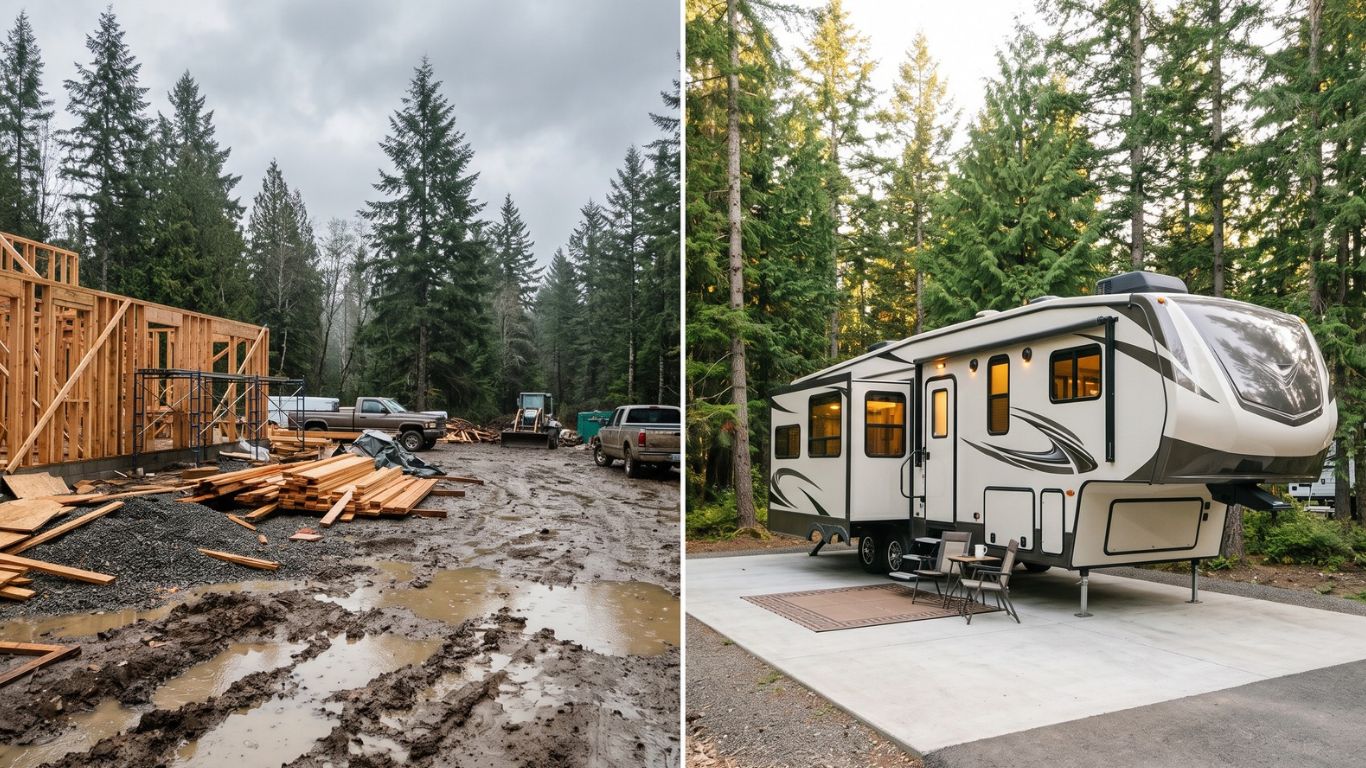
Every Coast renovation story starts the same way. Someone buys a lot, or inherits a tired bungalow, or finally signs the contract with the builder, and says the sentence that haunts the next eighteen months: “It should only take about six months.”
It will not take six months. Permits move at the speed of a ferry in fog, the tile arrives in March instead of January, and your framer is suddenly booked solid until the salmon run. Meanwhile you still need somewhere to live, and the Coast’s rental market hasn’t exactly been rolling out the welcome mat. So the question comes up sooner or later: can I just live in an RV or tiny home on wheels while the house gets built?
The answer is “sometimes, with conditions,” and the conditions matter more than most people realize. Let’s walk through them, and through the option a lot of owner-builders overlook: a serviced pad at an RV resort, where the hookups, hydro and mail are somebody else’s problem.
Nobody is being dishonest at the start. A well-run build still has a long list of things that can slip: permit review, inspections, material deliveries, trades who are juggling three jobs, and the occasional atmospheric river that turns your site into a very expensive pond. On the Sunshine Coast, add the ferry into the mix for anything you’re bringing across from the Lower Mainland.
Renovations are a different flavour of slow. Open up a wall and you’ll find something that wasn’t on the drawings. Wiring from the 1970s, a mystery pipe, a joist that has seen better decades. Each surprise adds days, and each day means you need to be sleeping somewhere with a working kettle.
The practical takeaway: plan your housing for the long version of the schedule, not the optimistic one. If you budget for twelve months and finish in nine, you’ll feel like a genius. If you budget for six and finish in fourteen, you’ll be sleeping on a friend’s pullout couch by Christmas.
Before you tow anything onto your own property, check the rules. They’re not what many people assume. The Sunshine Coast Regional District (SCRD) publishes its building permit information, and a few lines on that page are worth reading slowly.
On the page, the SCRD states that “recreational vehicles may be used to provide temporary accommodations for residents constructing a principal dwelling on the same parcel authorized under a valid building permit,” and that this is “subject to a property’s zoning.” That’s a real allowance, but notice how many conditions are packed into one sentence: you’re the resident doing the constructing, the dwelling is on the same parcel, a valid building permit is already in place, and your zoning has to allow it.
The same page also says that SCRD regulations “require all dwellings to be contained within a building constructed under a valid building permit,” and that “temporary dwellings are not permitted, nor can a RV or portable ‘Tiny House’ be used as a dwelling or residence.” It adds that temporary building permits can no longer be obtained under SCRD Building Bylaw No. 779.
In plain terms: parking an RV or a tiny home on wheels on a bare lot and calling it home is not something you can assume you’re allowed to do. The one clearly described exception is tied to constructing your principal dwelling under a valid permit, and even that depends on your zoning. Renovating an existing house isn’t spelled out on that page, so if that’s your situation, call the SCRD’s planning and building staff before you move anything onto the property. Rules differ by electoral area and by zone, and a quick phone call is far cheaper than a bylaw notice.
We’re an RV resort, not a planning department, so treat this as a signpost rather than advice about your parcel. The SCRD is the authority on that.

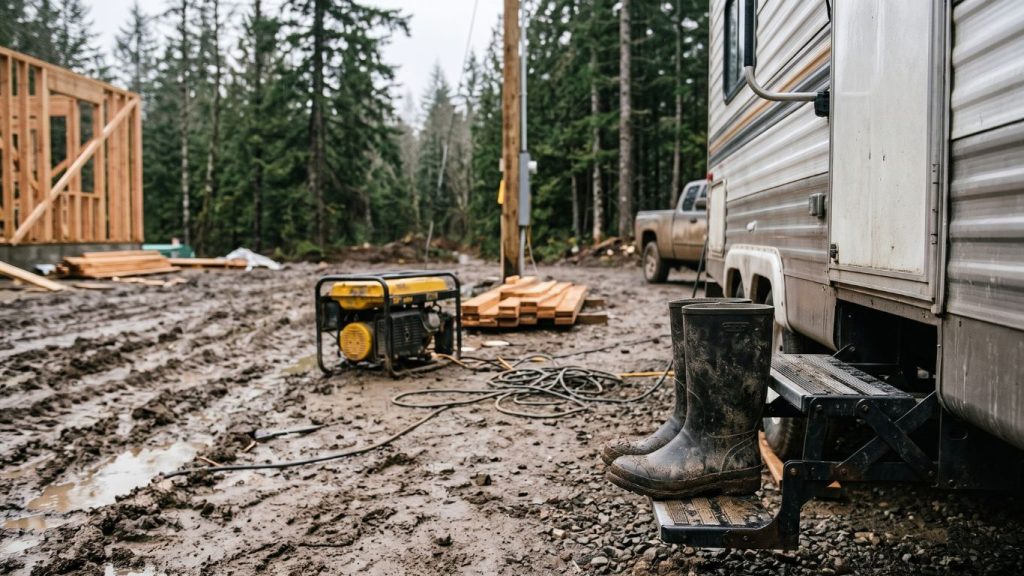
Even where it’s allowed, living in an RV on a build site isn’t a campsite with a hammer. Here’s what you’re signing yourself up for.
None of that is a deal-breaker for everyone. Some owner-builders love it. But if you’re also holding down a job, parenting, or working remotely, it adds up fast.
This is where a resort pad earns its keep. Halfmoon Bay RV Resort sits on 20 acres of forest, two minutes off the Sunshine Coast Highway, with about a 20-minute drive to Sechelt and roughly 40 minutes to the Langdale ferry terminal. There are 80 RV lots on site, with 30, 50, 100 and 200 amp service, plus water, sewer, cable TV and Wi-Fi at the pad. The resort lists a 24-hour laundromat, a 24-hour gym, dog parks, and Canada Post and Amazon package delivery too.
Here’s why that package makes sense when your real home is a pile of lumber.
You plug in, and the lights come on. No temporary pole, no generator, no hauling water. If your build is across the highway from a stretch of bush and the power connection is still weeks away, that alone can save your sanity. Higher-amp service also matters if you’ve got a bigger rig, since a large fifth wheel with all the appliances running is a very different animal from a small trailer. Our breakdown of 30, 50 and 100 amp pads explains which one suits which rig.
Tradespeople order things. Lots of things. Having a place with package delivery means the plumbing fixtures you’ve been waiting on won’t be left at the end of a gravel road. Ask the resort how it handles your particular deliveries before you rely on it.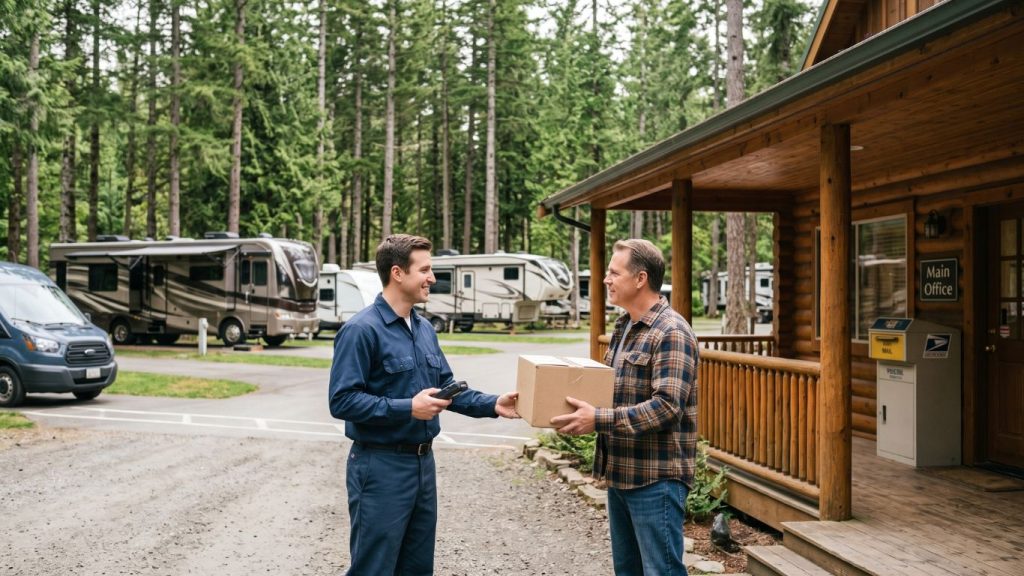
When you live somewhere else, your build site gets to be what it should be: a clean, safe place for people with hard hats to work. No kids’ bikes in the driveway, no laundry hanging off the scaffolding, and a lot fewer awkward conversations with your electrician about where to park.
Depending on where your lot is on the Coast, you may be a short drive from the job. Swing by on the way home, take photos, talk to the foreman, and then go back to a quiet pad where nobody is running a saw at 7 a.m.
If you’re going to live in an RV or tiny home on wheels for a year or more, think carefully about whether it’s actually set up for it. A rig that was brilliant for long weekends can feel cramped after the third month of rain.
It also helps to keep the legal side tidy. A long stay is a commitment on both sides, so read our checklist on signing a long-term RV pad lease in BC before you put pen to paper.
Not every park is set up for a nine-to-eighteen-month stay, and not every park wants one. Before you tow anything over, ask:
A good park will answer these without flinching. If you get vague answers, take that as an answer too.
A few small habits make the final stretch less painful.
Start tracking your move-out date backwards from your occupancy permit, not forwards from your wish list. Give your pad a realistic buffer, since occupancy tends to arrive later than the drywall finisher promised. Book your movers or your tow early, and keep an eye on the ferry schedule if anything big is coming over from the mainland; BC Ferries publishes its sailing schedules online, and summer weekends are not the moment to wing it.
If you’re bringing a second household’s worth of furniture into the new place, you’ll want somewhere to stage it. That’s another good reason to sort out storage early. And if you’re moving to the Coast for the first time, our guide to moving to the Sunshine Coast covers the bits that catch newcomers off guard.
You’ve got enough on your plate with permits, plans and a builder who communicates exclusively by text at 9 p.m. Where you sleep shouldn’t be one more thing on the list. Have a look at the available pads at Halfmoon Bay RV Resort, tell us a bit about your rig and your build timeline, and we’ll help you find a spot that works. You can also call the office at (604) 218-4757.
Bring the blueprints. We’ll supply the hookups and a decent view of the trees.
 See map of resort