


Moving to the Sunshine Coast BC can work very well if you want a smaller community, easier access to the outdoors, less city traffic and a different pace of daily life. It works less well if you need to be in Vancouver every weekday, depend on frequent specialist medical appointments, or expect city-level shopping and services on demand. Housing is not automatically cheap, the ferry becomes part of your calendar, and a car remains useful for many households.
That is the honest starting point.
The Sunshine Coast is beautiful, but relocating here is a housing and logistics decision before it is a scenery decision.
The lower Sunshine Coast is connected by Highway 101, but it is not connected to Metro Vancouver by road.
If you are arriving from Vancouver, you normally travel from Horseshoe Bay to Langdale by ferry and continue by road.
That one fact shapes almost everything about living on the Sunshine Coast.
The main communities feel different.
Gibsons is closest to Langdale. Sunshine Coast Tourism puts the drive from Langdale to Gibsons at about 10 minutes. It has shops, restaurants, services and relatively easy ferry access.
Roberts Creek sits between Gibsons and Sechelt. It feels more rural and spread out, while still being within practical driving distance of both towns.
Sechelt is the main service centre on the lower Coast. This is where many residents handle bigger grocery trips, medical appointments, banking, pharmacy stops and other everyday errands.
Halfmoon Bay is north of Sechelt. Sunshine Coast Tourism puts the drive from Sechelt to Halfmoon Bay at about 13 minutes. It is quieter and more residential, while Sechelt remains close enough for regular services.
Farther north, Pender Harbour and Madeira Park become more rural again.
If you are moving to the Sunshine Coast BC, choosing the right community is less about which one looks nicest in photos and more about how often you need the ferry, hospital, schools, groceries and work.
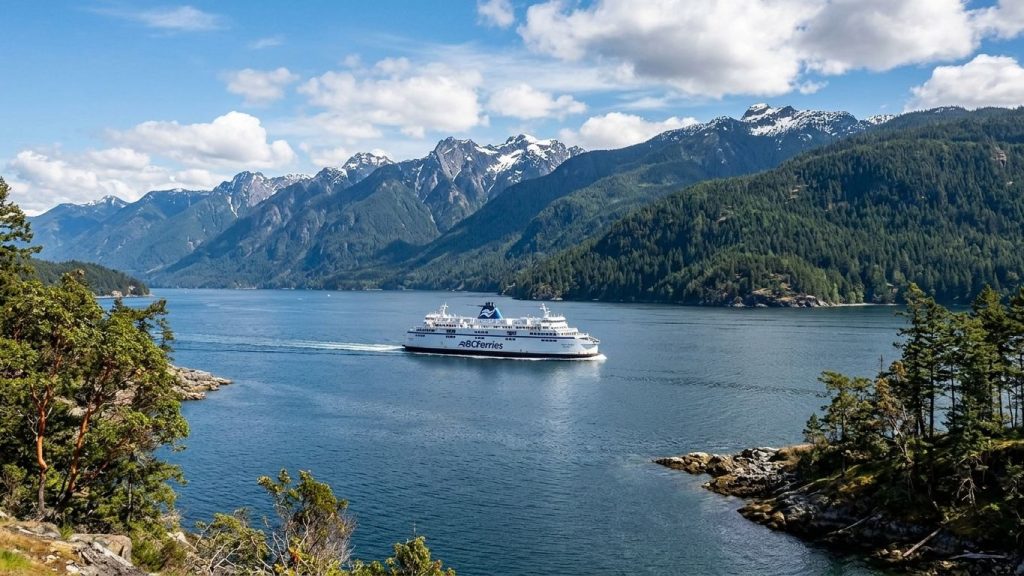
The ferry is the biggest practical difference between visiting the Sunshine Coast and living here.
The Langdale–Horseshoe Bay crossing itself takes roughly 40 minutes. BC Ferries currently lists the route at about 39–40 minutes.
But a 40-minute crossing does not make downtown Vancouver a 40-minute commute.
You still need to account for the drive to Langdale, check-in, possible sailing waits, loading and unloading, then travel from Horseshoe Bay into Vancouver.
Current Sunshine Coast transit connects Langdale with Sechelt and Halfmoon Bay, while TransLink’s 257 provides express service between Horseshoe Bay and downtown Vancouver.
BC Ferries schedules change by season and sometimes by day. A current fall 2026 operating pattern includes the following sailings. Always check the live schedule before travel.
| From Langdale to Horseshoe Bay | From Horseshoe Bay to Langdale |
|---|---|
| 6:20 am | 7:30 am |
| 8:40 am | 9:50 am |
| 11:00 am | 12:10 pm |
| 1:15 pm | 2:25 pm |
| 3:35 pm | 3:45 pm on some current schedules |
| 4:55 pm on some current schedules | 4:45 pm |
| 5:55 pm | 6:05 pm |
| 7:15 pm | 7:05 pm |
| 8:15 pm | 9:25 pm |
| 10:30 pm | 11:30 pm |
That is enough service for occasional city trips.
It does not remove the need to plan.
BC Ferries currently offers several fare types for a standard under-height vehicle and driver on the Horseshoe Bay–Langdale route. Saver fares on selected sailings are advertised from $39 to $59 return, while the current at-terminal option is listed at $74.85. BC Ferries notes that published figures can be affected by fuel rebates or surcharges.
| Travel choice | Current practical cost picture |
|---|---|
| Walk-on passenger | Lower cost than taking a vehicle; check the current passenger fare before travel |
| Saver vehicle fare | Currently advertised from $39–$59 return for a standard vehicle and driver on selected sailings |
| Prepaid or booked vehicle fare | Costs more than the lowest Saver option but provides greater planning certainty |
| At-terminal vehicle fare | Currently listed at $74.85 for the applicable standard vehicle/driver journey |
| Frequent Vancouver trips | Ferry costs should become a regular household budget line |
The more often you cross, the more important this becomes.
If you work remotely and go into Vancouver once a month, the ferry may be an inconvenience you can easily plan around.
If your employer expects you downtown four or five days a week, moving to the Sunshine Coast BC may create a difficult commute rather than solve a housing problem.
Sailings can also be delayed or cancelled because of operational or mechanical issues. BC Ferries advises travellers to check current conditions and service notices before travelling.
That is not a reason to avoid the Coast.
It is a reason to stop treating the ferry like a bridge.
The Sunshine Coast is not automatically the cheap version of Vancouver.
Housing can be lower in some situations, but supply is smaller and the difference is not always dramatic.
As of July 2026, Rentals.ca reported an average Vancouver one-bedroom asking rent of about $2,377 per month. A September 2026 Apartments.com market page reported a Sechelt one-bedroom average of about $2,210, but that local figure was based on a very small number of available apartments, so it should be treated as a market indicator rather than a perfect Coast-wide average.
That small gap is worth noticing.
If you are moving to the Sunshine Coast BC purely because you expect ordinary apartment rent to be half the Vancouver price, the numbers may disappoint you.
| Cost | Sunshine Coast reality | Vancouver reality |
|---|---|---|
| Housing | Sechelt can be cheaper than Vancouver, but rental supply is smaller and asking rents remain substantial | Larger rental market, but one-bedroom asking rents remain high |
| Groceries | Full grocery shopping is available in Sechelt; smaller communities have fewer choices and local top-up shopping can cost more | More supermarkets, warehouse options and price competition |
| Fuel | Prices change frequently; many Coast households drive regularly because communities are spread out | Fuel also varies, but transit can replace more car trips |
| Ferry | A real additional cost for households travelling frequently to Metro Vancouver | No ferry cost for ordinary travel within Metro Vancouver |
| Utilities | Depends heavily on housing type, heating and what rent includes | Also varies, but apartments may include some services |
| Internet | Good service is available in some communities, but exact speed and provider options depend on address | Generally broader provider and high-speed service availability |
A better way to judge the Sunshine Coast BC cost of living is to build your own monthly budget around your actual housing choice and travel habits.
Someone who works from home, owns a paid-off vehicle and crosses to Vancouver six times a year has a very different budget from somebody commuting weekly.
If housing cost is driving your decision, the cost of RV living BC comparison is also worth reading before assuming that any one housing type is automatically cheaper.
People moving to the Sunshine Coast BC generally look first at renting or buying a conventional home.
Those are still the main options.
But they are not the only ones.
Renting gives you flexibility and lets you learn the Coast before making a major commitment.
The drawback is limited inventory. Smaller markets can change quickly, and the exact home you need may not be available when you want it.
Buying can make sense if you are committed to staying long term and the purchase fits your finances.
Do not assume that leaving Metro Vancouver means inexpensive property. The Sunshine Coast is still a desirable coastal market.
Manufactured-home communities can offer smaller homes and a different cost structure from detached houses.
The important question is what you are buying: the home, the land, a share, or the right to occupy a site.

A year-round serviced RV or suitable tiny home on wheels can also be a legitimate housing option for some residents.
It is not the right choice for everyone.
You need to think about space, winter moisture, maintenance, insurance, site rules and whether the housing arrangement suits your long-term needs.
For someone already considering a smaller mobile home, renting a year-round RV lot vs buying one is a useful comparison.
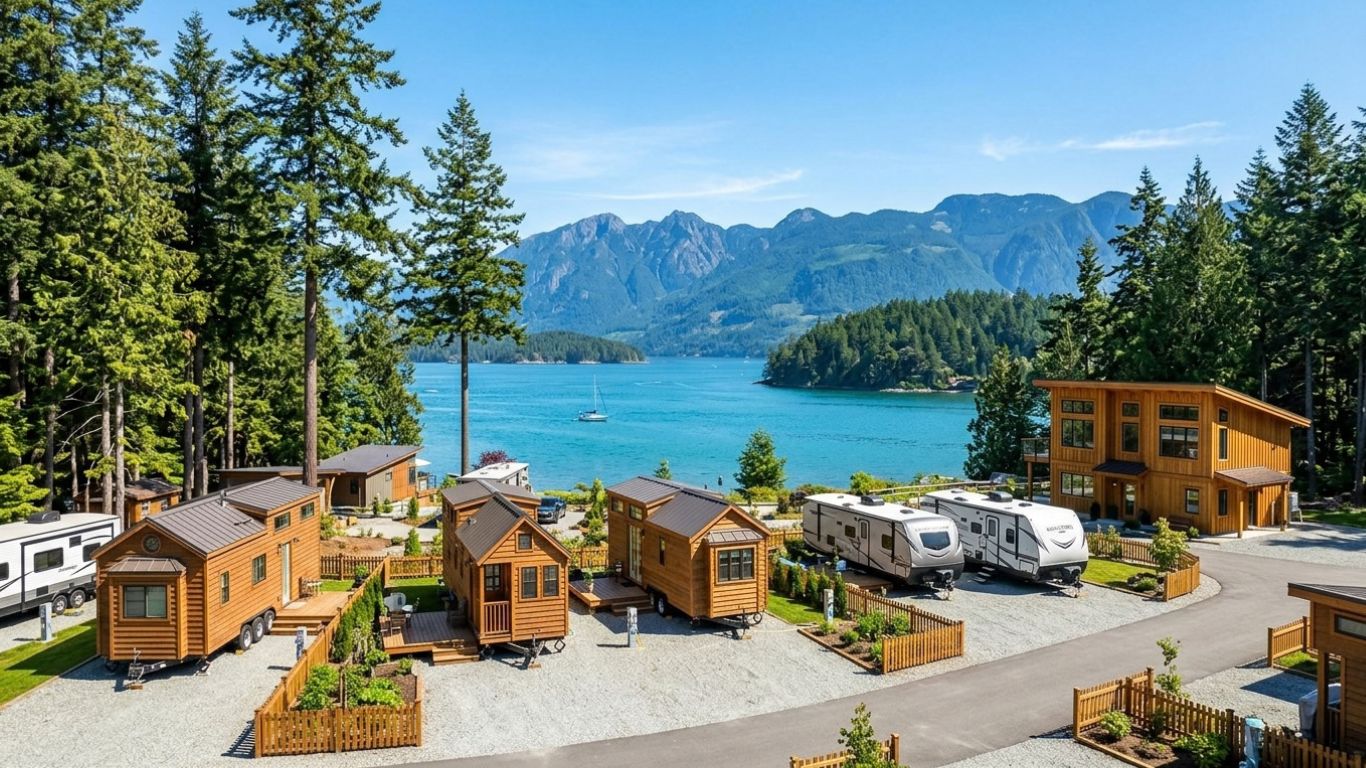
Halfmoon Bay RV Resort is one example of a year-round serviced RV and THOW community near Sechelt. Its role in this guide is not to suggest that everybody relocating to the Coast should live in an RV. It is simply one more housing category worth considering alongside apartments, houses and manufactured homes.

Working remotely on the Sunshine Coast is much more practical than it once was, but internet quality should be checked by address rather than assumed from the town name.
Rogers currently advertises home internet service in Sechelt with plans offering download speeds up to 2 Gbps under suitable network and equipment conditions. That does not mean every rural address on the Coast receives that speed.
Halfmoon Bay, Roberts Creek and more rural locations can have different options.
Before signing a lease or buying a home, remote workers should test the exact address for provider availability.
Your work setup may also need a backup.
That could mean mobile data, a second provider or satellite internet depending on location and job requirements.
The main advantage of remote work is obvious: if you only need to cross to Vancouver occasionally, ferry dependency becomes much easier to live with.
Local employment exists in healthcare, education, construction and trades, tourism and hospitality, retail, local government and other services.
But the job market is smaller than Metro Vancouver.
Do not relocate assuming you will find the same number of employers in the same profession after arrival.
Daily services are available, but living on the Sunshine Coast means accepting that not every service exists locally at Metro Vancouver scale.
| Service | What is available | What is limited |
|---|---|---|
| Medical | Sechelt | shíshálh Hospital operates 24/7 and serves communities including Halfmoon Bay; VCH lists emergency and several diagnostic and surgical services | Some specialist or highly complex care can still require travel off-Coast |
| Schools | School District 46 operates elementary and secondary schools across the Sunshine Coast, including Halfmoon Bay Elementary and Chatelech Secondary | Catchments and bus eligibility matter; specialised programmes may require travel within the district |
| Groceries | Halfmoon Bay has smaller local stores for top-ups, while Sechelt has larger grocery options | Less choice than Metro Vancouver, particularly for specialised products and bulk shopping |
| Banking | Everyday banking services are available in the main communities | Fewer physical branches and less choice than a large city |
| Trades | Local electricians, plumbers, builders and other trades serve the Coast | Specialist trades can have longer waits, especially during busy periods |
| Internet | High-speed services are available in parts of Sechelt and other communities | Speed and provider choice vary by exact address |
| Public transit | Sunshine Coast Transit runs from Langdale through Sechelt to Halfmoon Bay | Frequency, hours and geographic coverage are much more limited than Metro Vancouver |
Sechelt | shíshálh Hospital is a 63-bed facility, and its emergency department operates 24 hours a day, seven days a week.
School District 46 currently operates schools across the region, including Halfmoon Bay Elementary and Chatelech Secondary for families in this part of the Coast. The district also runs school-bus services based on catchments and eligibility.
For everyday supplies, grocery shopping near Halfmoon Bay is practical for smaller top-ups, while Sechelt is the more useful place for a full weekly shop.
Summer and winter can feel like two different versions of the same place.
Sunshine Coast Tourism describes summer as typically warm and dry, with daytime highs that can reach around 30°C, while winter is generally mild and moist, often around 2°C to 10°C at lower elevations.
Summer means:
Long daylight, busy beaches, more visitors, fuller ferries and more seasonal activity.
Winter means:
Rain, darker afternoons, quieter roads, fewer visitors and a much stronger focus on ordinary daily life.
Some tourism-oriented businesses reduce hours or close for part of the off-season.
That matters when you are relocating.
The café, activity or shop you loved in July may operate differently in January.
For RV residents, winter also means condensation, heating, water protection and moisture control. The winter RV living on the Sunshine Coast guide covers that side in detail.
The useful question is not whether you love the Sunshine Coast in August.
It is whether you still like your daily routine on a wet Tuesday in February.
One concern people have when moving to the Sunshine Coast BC is whether a smaller community will feel isolating.
It can, at first.
You do not automatically gain a social circle because you changed postal codes.
People tend to meet through ordinary repeated contact: schools, work, volunteering, neighbourhood groups, sports, dog walking, community events and local businesses.
The Coast also rewards people who become regulars.
Use the same café.
Walk the same trail.
Join a club.
Volunteer somewhere.
Say hello to neighbours.
That may sound obvious, but smaller communities often work through familiarity.
The existing guides to restaurants near Halfmoon Bay and Sechelt, Halfmoon Bay beaches and things to do in Halfmoon Bay are useful after you move for the same reason they are useful to visitors: they give you reasons to get out of the house and become familiar with the area.
Just do not confuse knowing the attractions with knowing the community.
That part takes time.
This section matters more than another paragraph about ocean views.
Even if you rarely go to Vancouver, family and friends might.
Deliveries, appointments, airport trips and work meetings can all involve the ferry.
Busy sailings may fill.
Delays happen.
Cancellations happen.
You learn to build more time into important trips.
Sechelt has a real hospital and local healthcare services.
That does not mean every specialist or advanced procedure is available locally.
If your household needs frequent specialist care in Metro Vancouver, calculate that travel before moving.

Smaller markets have less buying power and fewer competing stores.
You can shop carefully and use Sechelt for larger runs, but people moving from Metro Vancouver should not assume every food item will be cheaper.
Specialty products can also require planning.
Summer supports more tourism traffic.
Winter is quieter.
Some restaurants and tourism-oriented businesses reduce hours or close seasonally.
People who expect the same service level every month can find winter frustrating.
An occasional office day is manageable for many people.
A daily commute is another matter.
The road to Langdale, ferry check-in, crossing, Horseshoe Bay and final trip into Vancouver add up.
If your employer says “remote” but quietly means three or four office days every week, work out the route before signing a lease.
Local transit exists, but many households still depend heavily on a vehicle.
That is especially true outside central Sechelt and Gibsons.
A smaller market means fewer options.
If you need a particular combination—pet-friendly, accessible, three bedrooms, long-term lease, near a school—you may need patience.
Moving to the Sunshine Coast BC is probably a poor fit if you need the convenience of Metro Vancouver more than you dislike its cost or pace.
Think carefully before relocating if your life requires frequent downtown Vancouver travel, several specialist medical appointments each month, late-night city services, extensive public transit, a very large local job market, or constant access to specialised shopping.
It may also be wrong for you if ferry disruption makes you extremely anxious.
The Coast works best when most of your week can happen on the Coast.
If Vancouver remains the centre of your work, healthcare, shopping, family and social life, you may simply be moving your bed farther away from everything you still do.
That is not much of a relocation strategy.
Sometimes, but not automatically. Housing can be less expensive in some parts of the Coast, while groceries, driving and ferry travel can add costs. Compare your complete monthly budget rather than rent alone.
You can physically make the trip, but a daily commute is demanding. The ferry crossing itself is about 40 minutes, and you still need road travel, check-in and onward transportation.
BC Ferries runs multiple sailings in each direction throughout the day, but exact schedules change by season and date. Check current conditions before important travel.
Sechelt suits people who want the Coast while remaining close to the region’s main shopping, healthcare and everyday services. It is also a practical base for people who do not need to commute to Vancouver daily.
For many households, no. Halfmoon Bay is a short drive from Sechelt, while still feeling quieter and more residential. A vehicle is useful for normal errands.
Yes. Sechelt | shíshálh Hospital operates 24/7 and there are local health services. Some specialist care may still require travel to Metro Vancouver or another larger centre.
Yes. School District 46 operates elementary and secondary schools across the region. Families should check the catchment for their exact home address before moving.
Yes, many jobs can be done remotely from the Coast, but internet service varies by address. Confirm the exact connection available before signing a long-term housing agreement.
Winter is generally mild and moist compared with much of Canada. Rain, humidity and shorter days are more common concerns than prolonged severe cold at lower elevations.
Look at conventional rentals, home ownership, manufactured homes and, where appropriate, serviced RV or tiny-home communities. Compare legal structure, monthly cost, maintenance and long-term suitability before choosing.
Moving to the Sunshine Coast BC makes the most sense when your normal week fits the Coast.
Your job works here.
Your healthcare plan works here.
Your budget works here.
You can live with the ferry.
You have accepted that some things take longer.
And you have chosen housing because it suits your household, not simply because it looked cheaper online.
Before committing, spend time here outside summer.
Buy groceries.
Take the ferry at a busy time.
Drive to an appointment.
Try your internet connection.
Visit the neighbourhood after dark.
See what January feels like.
If year-round RV or THOW living is one of the housing options you are comparing, review the year-round RV lots at Halfmoon Bay alongside conventional rentals and ownership before deciding.

If a serviced RV or THOW lot fits the kind of smaller year-round home you are considering, review Halfmoon Bay’s current long-term lot information, then compare the numbers and practical details against the other housing options available to you.
The right reason to move is not that the Sunshine Coast looks good on a weekend.
It is that your ordinary life works here.
 See map of resort