


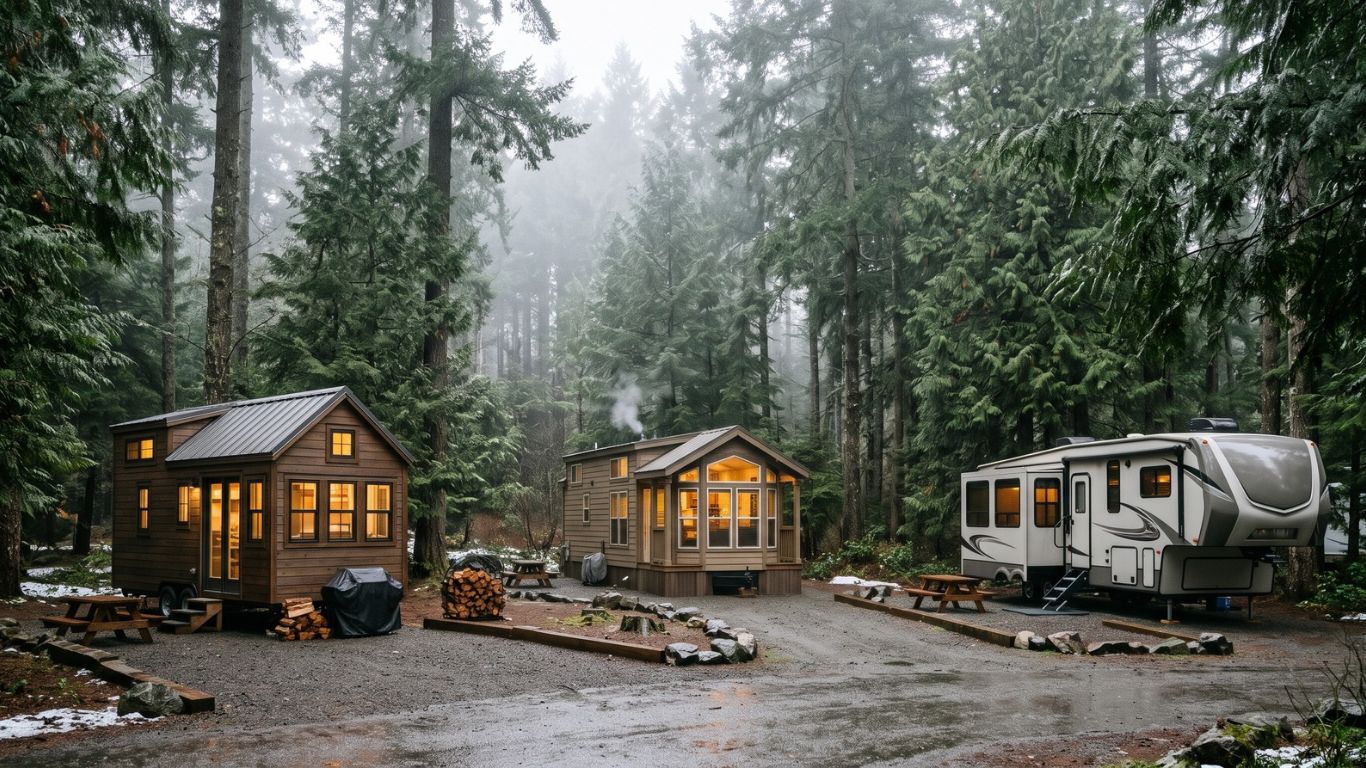
Every few weeks someone sends us a version of the same message: “I’m going to live in something on wheels year-round in BC. Tiny home, park model, or fifth wheel? Help.” Fair question. It’s also a bit like asking a Vancouverite which umbrella to buy. Everyone has a strong opinion, and most of them are standing under a different one.
So here’s the over-the-coffee version, minus the sales pitch. We’ll walk through what each rig actually is, how each one handles a Coast winter, what towing and pad size look like, and where the paperwork gets sticky. By the end you should know which one fits the way you plan to live, not just the one that looks best on Instagram.
These three get lumped together constantly, but they come from different worlds. That matters, because the world a rig comes from decides what standards it’s built to, who will insure it, and where it can legally sit.
A tiny home on wheels is a small, house-style dwelling built on a trailer chassis. Think real kitchen, sleeping loft, wood or fibre-cement siding, and an interior that feels more cabin than camper. Some are built by professional companies to a recognized standard. Others are built in a backyard by a very determined person with a YouTube habit. That difference is the single biggest factor in how welcome your tiny home will be in a park. We cover it in depth in our guide to THOW insurance and certification in BC.
For a lot of regional districts, certification is the dividing line. The Comox Valley Regional District, for example, notes that units built to the CSA Z240 RV standard are sold by RV dealers and fall under the Motor Vehicle Act, while homemade tiny houses built on a trailer chassis outside a CSA certification are treated very differently. You can read their wording on the CVRD R/V Dwelling and Tiny House Use page. Rules vary by municipality and regional district, so that page is one example, not a province-wide ruling.
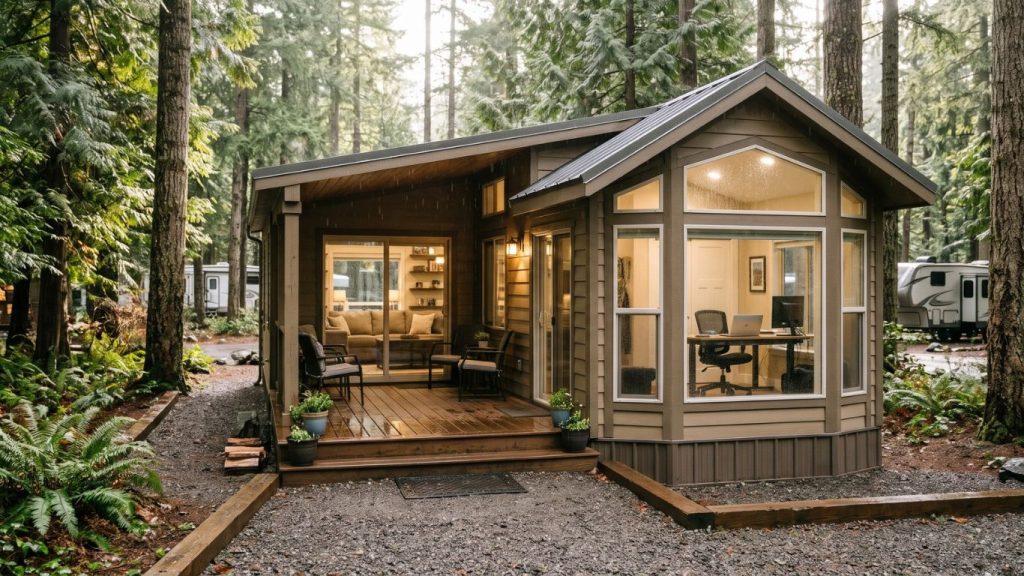
A park model is a recreational unit built to its own Canadian standard, the CSA Z241 series for park model trailers. It’s usually wider and more house-like than a travel trailer, and it’s designed to be set up in one place and left there. The Standards Council of Canada’s notice on park model trailers describes the series as covering the vehicular, construction, plumbing, propane and electrical requirements for these “recreational living units.”
The key word there is recreational. The CVRD page above describes park models as built for RV parks and campgrounds, and notes that the BC Building Code doesn’t recognize the Z241 standard. In plain terms: a park model is happiest when it lives in a park that welcomes them, and a park model on your own back forty may be a conversation with the building department.
A fifth wheel is the heavyweight of the towable RV world. It hooks to a hitch mounted in the bed of a pickup, which is how it gets that distinctive raised front section with the bedroom up top. It’s built to the CSA Z240 RV series, which the Standards Council of Canada describes in its standards database entry as setting dimensional and safety requirements for recreational vehicles. That same entry is also explicit that park model trailers fall under the separate Z241 series, which is a handy way to remember that these are different animals.
Fifth wheels are the rig most people picture when they think “full-time RVer.” They’re also the easiest of the three to move, resell, and get through the door of just about any RV park.
Let’s be honest about the weather. The Coast does not get a Prairie deep freeze, but it does get months of damp, grey, and drizzly, with the occasional cold snap to keep everyone humble. The real enemy here isn’t minus 30. It’s moisture. Condensation on windows, mould in storage cubbies, and a heating system that works hard but never quite dries the air out.
A well-built tiny home usually has the edge on insulation, because it’s designed like a small house rather than a lightweight camper. Thicker walls, better window packages, and real insulation in the floor are common on professional builds. The tradeoff is that a tight, well-insulated shell traps moisture just as well as it traps heat, so ventilation (a good range hood, a bathroom fan that actually vents outside, and a dehumidifier) matters more than people expect. Our winter RV living guide walks through the moisture routine that works on the Sunshine Coast.
Park models tend to be built with residential-style framing and bigger windows, so they feel roomy and bright in the grey months. That extra space is lovely when it’s pouring for the ninth day running. It also means more volume to heat and more glass to fight condensation on. Check the insulation package and the skirting plan before you buy one, not after.
Fifth wheels vary wildly. Some are four-season rated with enclosed, heated underbellies. Others are built for a summer on the road and will not thank you for a February in the rain. If a fifth wheel is on your list, look at the manufacturer’s stated cold-weather package, the tank heating, and the window quality. A heated hose, skirting, and a decent dehumidifier go a long way toward making a fifth wheel comfortable all year.
Floor plans are where these rigs really split personalities.
If you’re a remote worker, think about where the desk actually goes. A reliable connection helps too, and we’ve written about setting up internet for RV living on the Sunshine Coast if that’s on your checklist.
This is the section people skip until the day they need it.
Fifth wheels are made to be towed, but they need a properly rated pickup, and a half-ton won’t always cut it. Check the pin weight and the truck’s actual payload, not the brochure number. If you plan to move seasonally, this is the most straightforward rig to relocate, and plenty of drivers can hitch up and go in under an hour.
THOWs can be towed, but they’re often heavy, tall, and tricky to back into a tight pad. Many owners hire a professional hauler for the move rather than doing it themselves. That’s fine, as long as you budget for it. If you expect to move often, this is where a THOW gets expensive.
Park models are the least mobile of the group. They can be moved, but it usually involves a transport company, permits, and a fair bit of planning. Think of a park model as a place you move to, not a vehicle you travel in. That’s a feature if you want to stay put for years, and a headache if you suspect your plans might change.
Getting your rig onto the Coast is its own project, since the route runs through Horseshoe Bay and Langdale. Our ferry guide for RVs and trailers covers booking and what to expect with oversized loads, and it’s worth reading before you commit to anything tall or wide.
Here’s where the glossy photos stop mattering. Before you fall in love with any rig, ask three questions:
A factory-built fifth wheel or certified RV-style unit tends to have the clearest paper trail, because it’s built to an established standard and sold through dealers. A park model has its own standard in Z241, which is helpful, but it also means you should confirm the park will take one before you buy. A THOW can be a great fit, but a certified, professionally built one is a far easier conversation than an uncertified build.
Parks set their own rules on age, size, appearance and certification, and a lot of local governments have their own views on top of that. That’s why we put together a site checklist for tiny homes on wheels in BC. It’s the same set of questions worth asking whether you’re eyeing a THOW, a park model, or a fifth wheel.
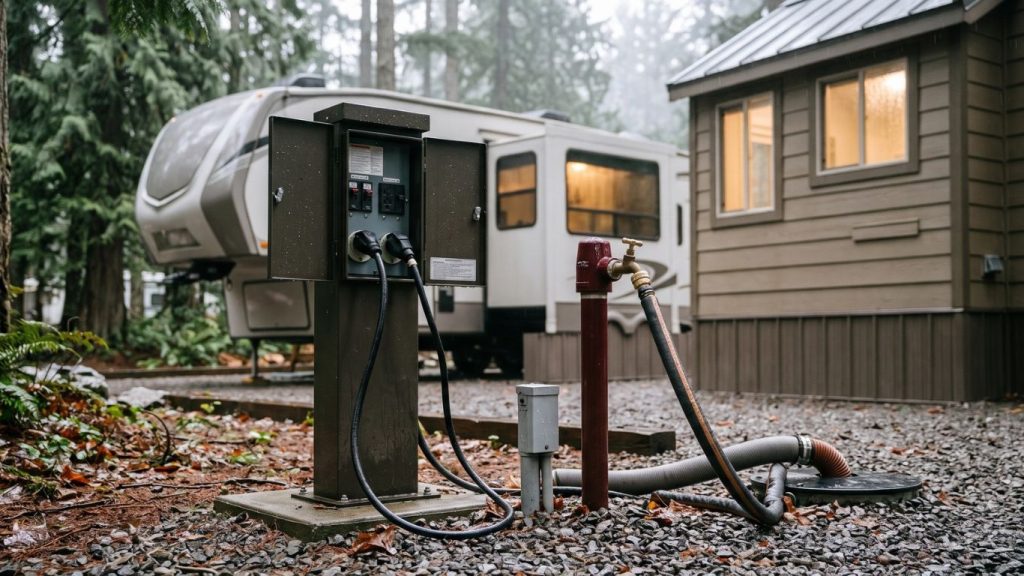
Whatever you choose, it has to plug into something. At Halfmoon Bay we offer 30-amp and 50-amp pedestals, frost-free water connections and direct septic and sewer taps, and we can accommodate small trailers, Class B and C motorhomes, big Class A rigs, fifth wheels and tiny homes on wheels. Bigger rigs and more electric heating mean more amperage, so it’s worth thinking about power before you pick a floor plan. Our explainer on 30 vs 50 vs 100 amp pads breaks that down without the confusing bits.
Also think about the practical footprint. A fifth wheel needs room for the truck, a THOW needs room to be backed in and levelled, and a park model needs room for decks, steps and skirting. Measure twice, then measure the pad.
Here’s a quick way to narrow it down.
You want the most house-like feel in a small footprint, you’ve confirmed the build is certified or otherwise acceptable to your park and insurer, and you’re planning to stay put for a good stretch. It’s a lovely lifestyle choice, and it’s the rig our tiny home pad rentals are built around.
Space matters most, you work from home or share your home with someone, and you’re confident you won’t want to move it. Make sure the park you’re targeting welcomes park models, and get that in writing before you buy.
You want flexibility. You might chase winters, you might change your mind, and you want a rig that parks almost anywhere and sells fairly easily down the road. Just make sure the one you pick is actually built for four seasons.
If you’re still on the fence, our broader guides on living in an RV year-round in BC and the best year-round RV parks in BC are good next reads.
The best test of any rig is parking it on a real pad and living in it through a wet October week. If you’re weighing a THOW, a park model or a fifth wheel and want to know which of our sites would suit it, send us the make, model and dimensions and we’ll tell you straight whether it’ll fit. Browse the available pads and submit a request, and we’ll get back to you before the next ferry lineup clears.
 See map of resort