


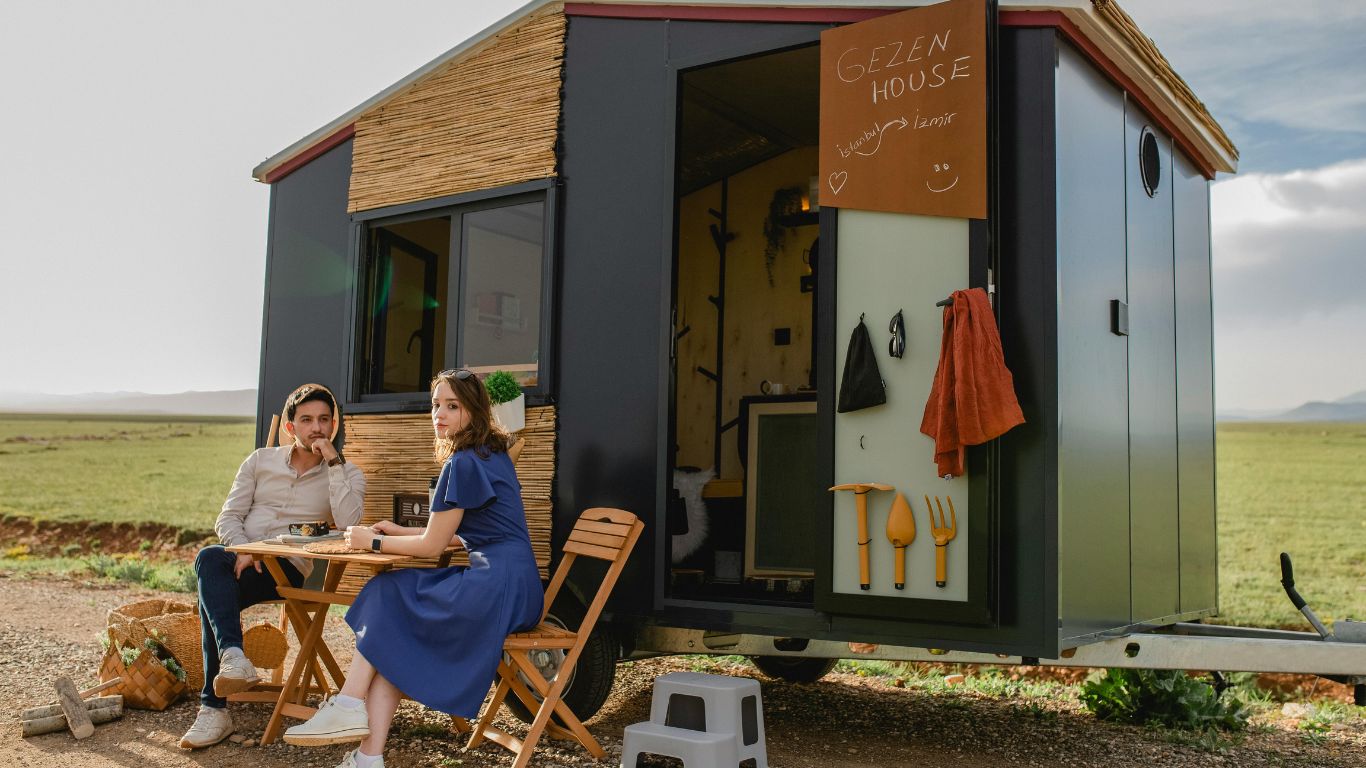
You have finished the build.
The tiny home is sitting on its trailer.
The electrical system is installed.
The kitchen works.
The bathroom works.
And now comes the question that can be harder than building the home:
Where can you actually put it?
People searching for THOW pads for rent are usually well past the dreaming stage.
They already own a tiny house on wheels, have one under construction, or are preparing to take delivery.
What they need now is a site with three things:
That final point matters.
A beautiful tiny home is not automatically approved for residential use on any empty piece of land in British Columbia.
The unit, the electrical and gas systems, the land use, the park arrangement, and the actual site all need to work together.
For owners trying to rent a pad for a tiny house in BC, Halfmoon Bay RV Resort on the Sunshine Coast offers a useful place to start.
The resort publicly describes itself as a year-round, fully serviced RV and Tiny Home on Wheels community with approximately 80 RV pads on 20 forested acres in Halfmoon Bay.
But THOW acceptance is not automatic.
The smart process is:
Check the home. Check the pad. Check the utilities. Get written acceptance. Then arrange transport.

The word legal gets used far too casually around tiny homes.
Someone may tell you:
“It’s on wheels, so it is an RV.”
Or:
“It’s private land, so zoning doesn’t matter.”
Neither statement is safe to rely on.
For practical purposes, a THOW placement has several separate layers.
The electrical, gas, plumbing, structural, and vehicle-related aspects of the tiny home need to match whatever standards or approvals apply to that particular unit.
The pad needs enough room, suitable access, compatible power, potable water, sewer, drainage, and any other services the home needs.
The property has to permit the intended use under the applicable local planning and zoning framework.
Halfmoon Bay sits within SCRD Electoral Area B, where land use is regulated through Zoning Bylaw 722. The SCRD specifically tells property owners to confirm a property’s zoning designation through its Property Viewer and then check the regulations that apply to that zone.
You also need to understand what legal agreement gives you the right to occupy the pad.
That agreement might not automatically be the same as a normal apartment tenancy.
So when searching for legal tiny home parking spaces, do not look for one magic word.
Look for a complete placement that works from all four angles.
This is an important distinction.
Halfmoon Bay RV Resort does not merely advertise conventional motorhomes and travel trailers.
Its public website specifically names:
RVs & Tiny Homes (THOWs)
as part of its year-round serviced-living community.
That makes Halfmoon Bay relevant to owners who already have a THOW and need to find a suitable long-term site.
However, the resort’s own THOW guidance makes another point equally clear:
Every individual THOW still needs to be reviewed.
Owners should be ready to provide details such as:
Before arranging transport, review the resort’s THOW living in BC guide.
That is much safer than moving a 15,000-pound home across a ferry and asking questions afterwards.
Sometimes.
But this question needs more care than simply saying:
“Every legal tiny home must be CSA Z240.”
That is not accurate.
CSA Z240 RV is the Canadian standard commonly associated with recreational vehicles.
Technical Safety BC says recreational vehicles used in BC must display an acceptable certification or approval mark for their electrical systems, and it identifies the CSA Z240 RV series as the Canadian recreational-vehicle standard.
But not every structure commonly called a “tiny house on wheels” is necessarily classified the same way.
Depending on the unit, you may encounter standards or approval pathways involving:
The correct question is therefore:
What standard or approval applies to my specific home and intended use?
Do not remove labels.
Do not hide missing certification.
And do not assume a homemade electrical system becomes approved simply because the home has wheels.
For recreational vehicles used in British Columbia, Technical Safety BC requires certification or an acceptable approval mark for relevant electrical equipment.
Its current 2025 directive covers integrated wiring and equipment connected to external electrical supplies, including on-board generators and inverters.
For a THOW applicant, that means management may reasonably want to see:
If the home has been substantially modified after certification, disclose that too.
A certification sticker is useful.
A certification sticker from before somebody completely rewired the home in their driveway may not answer every question.
A common search requirement is a 50-amp tiny home pad.
Many THOWs do use 50-amp electrical service.
But not all of them.
Your home may have:
All of those choices affect power demand.
Halfmoon Bay RV Resort currently lists electrical services of 30, 50, 100, and 200 amps, depending on the pad.
That is useful for THOW owners because the park has more than one electrical configuration.
It does not mean every available site has a dedicated 50-amp connection.
When applying, provide the exact service your THOW requires.
Do not choose a pad based only on whether the plug looks correct.
Management should know:
If your THOW has electric heat, induction cooking, a large electric water heater, laundry, and several other high-demand appliances, 50 amps may be important.
If it was designed around a different service, use the builder’s specifications.
An adapter can change the physical plug.
It cannot magically increase the safe capacity of the home or pedestal.
Halfmoon Bay supplies potable water to its RV pads.
Its FAQ says the underground lines reaching individual pads are ¾ inch, with a ½-inch hose-bib connection for the resident’s water line.
Your THOW therefore needs a compatible way to receive water.
Before applying, identify whether the home uses:
Also measure where the inlet sits on the home.
A perfectly good water connection becomes much less helpful if it is 40 feet away on the opposite side of the THOW.
Long-term THOW owners usually want a much simpler wastewater arrangement than moving portable tanks around.
Halfmoon Bay’s FAQ says all RV pads have 4-inch sewer connections.
That can support longer-term setups when the THOW’s wastewater system is compatible.
Your home may use:
Before moving, provide:
Do not assume that having a 4-inch site connection means every homemade THOW plumbing arrangement can simply be attached to it.
The home’s system still needs to be safe and compatible.
Grey water is wastewater.
It does not become harmless because it came from a shower or kitchen sink.
Do not plan to drain it:
Your THOW should connect to the appropriate sewer system in the way accepted by the resort.
This is one of the major benefits of a proper THOW pad for rent over improvising on undeveloped land.
The infrastructure is already there.
THOW owners sometimes quote only the trailer deck length.
That can be misleading.
Management needs the finished dimensions.
Measure:
A home on a 28-foot trailer may be more than 30 feet long overall once the hitch and building overhangs are counted.
Use the finished number.
One useful feature of the resort is that the pads are not all identical.
Current property pages show substantial variation.
For example, some Landing pads are around 25 feet wide by 60 feet long, while available Yukon pads are listed around 29 feet by 106 feet and 28 feet by 118 feet. A current White Horse listing is approximately 50 feet by 150 feet with 200-amp power.
That does not mean those particular pads are automatically approved for your THOW.
It shows why matching the home to the actual pad is more useful than searching for one standard “tiny home lot size.”
Review current Halfmoon Bay pad options, then send management your exact dimensions.
A THOW can fit perfectly on the destination pad and still be impossible to deliver.
The transport route matters.
Before booking transport, check:
Also identify whether the transport truck can leave after placing the home.
For larger or unusually shaped THOWs, management may want to review the delivery plan before giving final site approval.
That is a good thing.
Finding out that a home cannot make the final turn is much cheaper on paper than halfway through delivery day.
Tiny homes can be heavy.
The final weight may include:
Do not rely only on a brochure’s dry weight.
Provide an accurate finished weight where possible.
The pad also needs to support the home according to the builder’s levelling and chassis-support instructions.
Randomly adding blocks under convenient-looking parts of the frame is not a structural plan.
This is where the article needs to be precise.
The resort publicly promotes year-round RV and THOW living.
It is also listed by Sunshine Coast Tourism as an open-year-round campground with 80 RV sites offering water, sewage, electricity, and daily, weekly, monthly, or long-term rentals.
However, I could not independently confirm from an official SCRD property record the exact zoning designation, permit conditions, or parcel-specific wording that applies to 9423 Stephens Way.
That means this article should not make the blanket statement:
“Every THOW at Halfmoon Bay is legally permitted by zoning.”
A better statement is:
Halfmoon Bay RV Resort publicly accepts THOW applications and operates a year-round serviced RV/THOW community, but each applicant should obtain written confirmation that the specific home, site, and intended occupancy are accepted before transport.
For local land-use verification, the SCRD provides its Zoning Bylaw and Property Viewer information.
This protects both the resident and the resort from relying on assumptions.
A legal or accepted site still does not mean every home is suitable.
Imagine two THOWs.
Both are called tiny houses on wheels.
They are not equally easy to place.
That is why screening the home is as important as screening the resident.
Create one digital folder before applying.
Include:
A complete application makes the fit review much easier.
If your tiny home uses propane, the gas system deserves the same attention as the electrical system.
Technical Safety BC recognizes different requirements depending on whether equipment is associated with a recreational vehicle, park model, manufactured home, or factory-built structure. Its guidance references CSA Z240 RV, CSA Z241, CSA A277, and other standards in connection with mobile units and gas systems.
Tell management whether propane supplies:
For repairs or alterations to an RV-type gas system, use appropriately qualified technicians.
Do not treat a propane installation as a DIY workaround for an electrical problem.
Halfmoon Bay operates year-round.
That means a THOW placed for residency needs to work in more than summer weather.
The Sunshine Coast has relatively mild coastal winters, but residents still deal with:
Your winter plan may need:
If your THOW was built mainly for warm-season use, ask the builder what is required before committing to a year-round site.
Maybe.
Do not assume.
Long-term THOW residents often want to add:
Ask management first.
Exterior additions can affect:
Get written approval before building anything fixed or semi-fixed.
A THOW should not arrive as a 300-square-foot home and slowly grow into a bungalow with wheels somewhere underneath.
This is another area where assumptions can create problems.
Halfmoon Bay’s own long-stay guidance discusses both monthly and yearly arrangements as general options to ask about, but the public resort pages do not currently publish a standard menu promising:
Its general rental guide specifically tells residents to ask whether the agreement is month-to-month or fixed term and to review deposits, notice requirements, and move-out terms.
So if you want a 12-month arrangement, ask for one.
If you prefer monthly flexibility, ask whether that is available.
Do not assume either structure until you see the agreement.
BC law distinguishes between different arrangements.
The Province explains that a manufactured-home site tenancy can be covered by the Manufactured Home Park Tenancy Act, while a licence-to-occupy arrangement falls outside that Act.
The actual facts of the arrangement matter.
A monthly payment by itself does not automatically determine which law applies.
This matters because rights involving:
can depend on the legal relationship.
If your THOW will be your long-term home and the agreement’s legal status is important to you, consider independent legal advice before signing.
The content brief for this article suggested explaining standard pad security deposits.
Halfmoon Bay’s public pages do not publish a standard THOW security-deposit amount.
There is another reason to be careful.
If an arrangement qualifies as a manufactured-home park tenancy under BC law, the Province says landlords cannot charge a security or damage deposit for that manufactured-home site tenancy.
Other types of agreements may operate differently.
So the right wording is not:
“Halfmoon Bay charges a standard $X pad deposit.”
The right question is:
“What type of agreement applies, and are any deposits, move-in charges, utility deposits, or other upfront payments required under that agreement?”
Get the answer in writing.
Again, legal classification matters.
Under the Manufactured Home Park Tenancy Act, landlords cannot charge applicants for accepting, processing, or investigating a tenancy application.
That does not mean every possible campground, licence, or occupancy arrangement is governed by that Act.
Ask management:
The important thing is knowing before you pay.
Halfmoon Bay’s FAQ says the resort considers tenant selection an important part of maintaining a safe and peaceful community.
The website does not publish a detailed formal THOW screening checklist.
A reasonable application may therefore involve questions about:
Management may also request additional information.
Do not invent answers.
If the home has been modified, say so.
If two vehicles are coming, say two.
Long-term communities work better when the application and real move-in situation match.
At minimum, try to confirm:
If anything is important enough that moving would depend on it, put it in writing.
“Someone told me on the phone” is not much comfort when the tiny home is already on a transport truck.

A proper full-hookup site removes several of the biggest problems tiny-home owners face when trying to improvise a location.
You do not want to design long-term living around:
A serviced pad gives the home a much more practical base.
At Halfmoon Bay, publicly listed infrastructure includes:
That is why the site itself matters almost as much as the tiny home.
Use this checklist.
Length: _____
Width: _____
Height: _____
Weight: _____
Voltage: _____
Amperage: _____
Plug type: _____
Main panel: _____
Inlet type: _____
Inlet location: _____
Pressure requirement: _____
Outlet size: _____
Outlet height: _____
Outlet location: _____
Holding tanks: Yes / No
Electric: Yes / No
Propane: Yes / No
Heat pump: Yes / No
Tow vehicle: _____
Overall transport length: _____
Special access needs: _____
Send that information with your enquiry.
It gives management something useful to evaluate.
Your application may need more work if:
Fix these issues before transport.
It is much cheaper while the tiny home is still where it is.
For owners seeking THOW pads for rent, Halfmoon Bay offers several practical advantages.
It is:
It also allows you to live in a quieter forested setting while keeping groceries, healthcare, fuel, and other Sechelt services within practical driving distance.
For many tiny-home owners, that is exactly what they were trying to find when they started searching legal tiny home parking spaces.
Not raw land.
Not a temporary driveway.
A proper serviced home base.

Yes, suitable parks and properties may accept tiny homes on wheels.
But you need to confirm that the specific home, property use, utilities, agreement, and placement are suitable.
Do not assume every RV park accepts THOWs.
Yes, Halfmoon Bay publicly describes itself as a year-round RV and Tiny Home on Wheels community.
Individual THOWs still need site and technical approval before placement.
No blanket rule like that should be used.
CSA Z240 RV applies to recreational vehicles, while other factory-built or park-model structures may fall under different standards or approval processes.
Identify what applies to your exact unit.
Halfmoon Bay lists 50-amp electrical service on selected pads, as well as 30-, 100-, and 200-amp services elsewhere in the resort.
Availability depends on the pad.
The resort states that every RV pad has a 4-inch sewer connection.
Your THOW’s grey- and black-water system still needs to be compatible with the site connection.
There is no one published THOW maximum that should be applied to every pad.
The resort has pads with substantially different dimensions.
Submit the home’s finished length, width, height, weight, and delivery requirements so management can assess actual fit.
Halfmoon Bay publicly operates and markets itself as a year-round RV and THOW community.
However, this article does not independently certify the exact parcel zoning designation or permit conditions.
Applicants who need parcel-specific legal confirmation should obtain it from management and, where necessary, the relevant planning authority.
Possibly, depending on the arrangement currently offered.
The resort’s public pages discuss monthly and longer-term stays but do not publish a standard 12-month THOW contract available to every applicant.
Ask for the current agreement options.
Halfmoon Bay does not publicly publish one standard THOW pad security-deposit amount.
Whether a deposit is legally permitted can also depend on the type of occupancy agreement.
Review the actual contract before paying.
At minimum, prepare:
No.
Get written acceptance for the specific home and site first.
Transport should be one of the last steps, not the first.
Searching for THOW pads for rent is different from searching for an RV campsite.
Your tiny home may represent years of planning and a substantial financial investment.
You do not want its final placement to depend on a handshake and an extension cord.
A proper THOW site should match:
And the agreement should clearly explain what you are paying for and how long you may stay.
Halfmoon Bay RV Resort gives THOW owners a serious starting point because the resort openly includes tiny homes on wheels in its year-round community and offers a wide range of serviced pad sizes and electrical capacities.
But responsible placement still means checking the exact home.
That protects you.
It protects the property.
And it makes the move much more likely to go smoothly.
The best sequence is simple:
Then move.
Not before.
If your THOW is complete or nearing delivery, prepare:
Then check your THOW pad fit and submit a residency request.
The resort’s current live form asks for RV details, vehicle count, move-in date, and contact information. It does not currently publish a dedicated THOW-only residency form.
If a dedicated Check Pad Fit & Apply for Residency page is created later, this CTA should link directly to that form.
 See map of resort